

The world speeds up when the year starts to wind down — which is exactly why this can become a simpler season instead of a stressful one.
More plans, more noise, more things that can’t wait until January.
But what if this season wasn’t about keeping up — what if it was about setting up?
Somewhere between the checklists and the quiet moments, you start to notice a different rhythm — one that invites you to slow down and rebuild what keeps you steady.
A simpler season isn’t about pausing everything; it’s about designing better systems that keep working when life gets busy again. The way your money flows. The routines that hold your days together. The boundaries that protect your focus.
Because what you carry into what’s ahead shouldn’t be more effort — it should be more ease.
Notice What’s Working (and What’s Not)
A simpler season starts with awareness — paying attention to what’s quietly holding you together and what’s quietly wearing you down.
Most of us drift through the year on autopilot — same spending habits, same routines, same noise. We add new goals but rarely question the systems behind them. The result is a life that looks full but feels scattered.
Before you change anything, pause long enough to see the patterns.
Which habits give you energy instead of taking it?
Which financial systems actually make your week smoother — and which just add one more login, one more reminder, one more thing to manage?
This reflection doesn’t need to take hours. Sometimes clarity comes from a single glance at your calendar or a few quiet minutes with a notebook. The point is to notice where the friction lives — so the rest of this season can become simpler by design, not by accident.
Design Systems That Support You (Money + Habits)
Awareness is powerful, but it’s only the first half of the work. Once you see what’s draining your time or money, the next step is building systems that do the heavy lifting for you.
Start with the areas that cause the most quiet stress:
- Bills and spending. If you still juggle due dates, build one small automation today. Set every recurring payment to clear from the same account, on the same week. Simplicity isn’t about spreadsheets — it’s about predictability.
- Habits and routines. Pair a habit you already do with one you want to strengthen. Drink water right after coffee. Review your budget while the laundry runs. Small anchors create consistency faster than motivation ever will.
- Mental bandwidth. Reduce decisions you don’t need to make. Same breakfast, same playlist, same two-minute tidy. Each micro-rule gives you back focus for what actually matters.
Systems protect your energy so you can spend it where progress happens. They’re not about control; they’re about removing the friction that keeps you from showing up at your best.
When you build a few steady systems now, you start the new year already lighter — not scrambling to reset, but quietly carrying momentum forward.
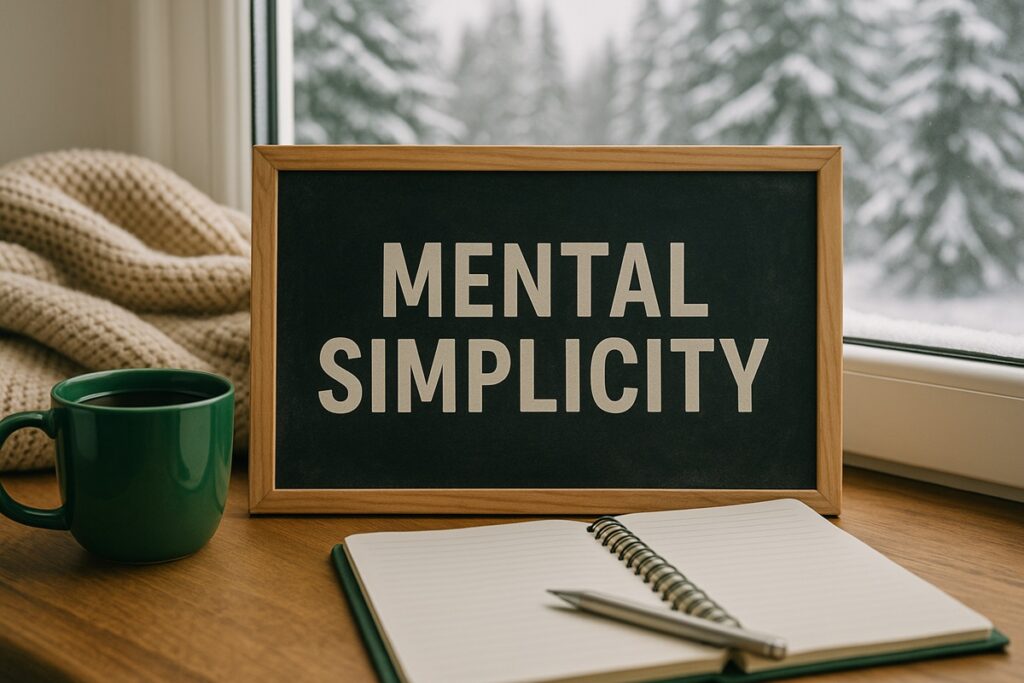
Keep a simpler season Going (How to Maintain Your Systems All Year)
You don’t need a dozen new routines — just one or two small systems that make everyday life run smoother. Start here and keep what sticks.
Review and Reset Weekly
Simplicity sticks when it’s easy to maintain.
Run a short review at the same time each week — fifteen minutes, max. Look at what worked, what felt heavy, and where a single tweak could make things lighter.
- 15-Minute Review: Bills, calendar, one small win. If it takes longer than that, simplify the checklist.
- Friction Audit: Ask, What felt annoying? What never got used? Remove one app, login, or reminder.
You don’t need more organization; you need less friction.
Simplify and Streamline
Build systems that do more of the work for you.
- The Rule of Three: Each week, pick one money action, one habit anchor, and one cleanup task.
- Minimum Routines: Define the floor, not the ceiling — 10-minute walk, 8 glasses of water, pay yourself first.
- Automation Reminders: Revisit your automations once a season to make sure they still match your life.
Better systems aren’t bigger; they’re smoother.
Protect Your Margin
A simpler season isn’t possible without space.
- Boundaries: One no-meeting evening or phone-free hour each week.
- Reset Recipe: A short checklist — Tidy surface → Refill water → Open dashboard → Five deep breaths.
- Proof Tracking: Mark a ✓ on days the system ran. Stacks of tiny checks build quiet momentum.
Digital Security System: Protect your focus and finances online, too. I use NordVPN whenever I’m banking, using Wi-Fi on the go, or working remotely. It’s one of the simplest ways to keep your systems safe in the background.
Protect your margin — and your systems will protect you.

End the Year with Ease
A simpler season isn’t about doing less — it’s about doing what matters with less effort.
Each small system you build becomes proof that calm and progress can exist together.
You don’t have to overhaul everything. Choose one space to simplify — your mornings, your money, your routines — and let the results speak for themselves. When you see the difference, expand it slowly.
That’s how momentum works: it builds quietly, one steady decision at a time.
If you ever need a reminder that consistency matters more than intensity, read The Power of Small Wins. It’s a quick read on why small actions change everything — and it pairs perfectly with this one.
So, take a deep breath. Look at what’s ahead.
And remember: a simpler season starts now — and it stays with you when the new year begins.
If you’d like more calm, practical systems like this, join Earned Future Weekly — one steady idea every Monday morning.