

I used to think budgeting meant sitting down with perfect focus and a clean month ahead. Real life doesn’t do that. It shows up with uneven paychecks, surprise expenses, and weeks that blur together. That’s why learning to budget your money has to work even when you’re tired and busy — not just when you’re motivated.
Most people don’t fail at budgeting because they don’t care. They fail because the systems they try to use assume ideal conditions: time, energy, and constant attention. When those systems fall apart, people assume the problem is them.
It’s not.
Budgeting should feel like a quiet structure that supports you — not another thing competing for your attention.
What “Budgeting” Is Actually Supposed to Do
Before we talk about how to budget your money, it helps to reset what budgeting is for.
A budget isn’t meant to control you. It’s meant to remove uncertainty.
When your budget works, you already know:
- what’s handled
- what’s flexible
- and what’s quietly moving you forward
You’re not guessing every time you spend. You’re not checking balances constantly. The system does the heavy lifting so you don’t have to.
If your current approach requires daily attention or constant willpower, it’s not broken — it’s just overbuilt.
Step 1: See the Full Picture Before You Budget Your Money
Most people start budgeting in the wrong place. They jump straight into categories, percentages, or apps without first seeing their money as a whole.
Here’s where to actually begin.
Sit down with a notebook or spreadsheet and write:
- your monthly take-home income
- the expenses that show up no matter what (housing, utilities, insurance, minimum debt payments)
Don’t organize yet. Don’t optimize. Just get it out of your head and onto one page.
This step matters more than people expect. For most, this is the first moment money stops feeling abstract. You’re no longer reacting — you’re orienting yourself.
If you’ve read Five Simple Money Habits That Help You Reach Financial Freedom, this is the awareness step in action.
Step 2: Decide What Should Run Automatically When You Budget Your Money
Once you can see the full picture, the next question becomes much simpler: which decisions don’t actually need to be made every month? In other words, where can you remove repetition instead of relying on memory? This is where budgeting starts to feel easier to maintain, because fewer decisions mean less friction and a system that holds up even when life gets busy.
Start by automating the predictable parts:
- fixed bills
- recurring payments
- savings transfers that happen right after payday
When those things run automatically, you stop spending mental energy remembering and checking. The system works even when your attention is elsewhere.
This is the same idea behind Pay Yourself First. When money moves early and automatically, progress happens quietly in the background.
You’re not giving up control — you’re choosing where control actually matters.

Step 3: Give the Rest of Your Money Simple Boundaries
Now that the essentials are handled, you don’t need dozens of categories to budget your money well.
Most people do better with a few broad lanes that match real life:
- what keeps life running
- what supports your lifestyle
- a small buffer for the unexpected
- and what builds future stability
These aren’t strict limits. They’re guardrails.
The goal isn’t perfection. It’s clarity without micromanagement — the same principle you see in The 1% System. Simple systems get used. Complex ones get abandoned.
Step 4: Build Margin on Purpose
This is where most budgets quietly fail. When every dollar is assigned, the system may look good on paper; however, it becomes fragile in real life. As soon as a surprise expense shows up, everything can feel broken. That’s why margin matters. By leaving a little space on purpose, your budget stays calm and flexible instead of rigid, which ultimately makes it far easier to maintain over time.
Leaving a small amount unassigned each month gives your plan room to breathe. It absorbs irregular expenses and removes the constant feeling that you’re one mistake away from falling behind.
This connects directly with How to Build an Emergency Fund That Grows. Stability isn’t created by perfect planning — it’s created by space.
Step 5: Review Once a Month and Walk Away
You don’t need to watch your budget every day.
Once a month is enough.
Check that:
- bills ran correctly
- savings happened
- nothing drifted too far off course
Make one adjustment if needed — then stop.
A budget should support your life, not become the center of it.
A Simple Way to Budget Your Money in One Place
If you’re reading this and thinking, “This makes sense, but I don’t want to build a system from scratch,” that’s fair.
When I went through this process myself, the hardest part wasn’t the math — it was having one place where everything lived. Income, expenses, margin, and reflection all need a home you’ll actually return to.
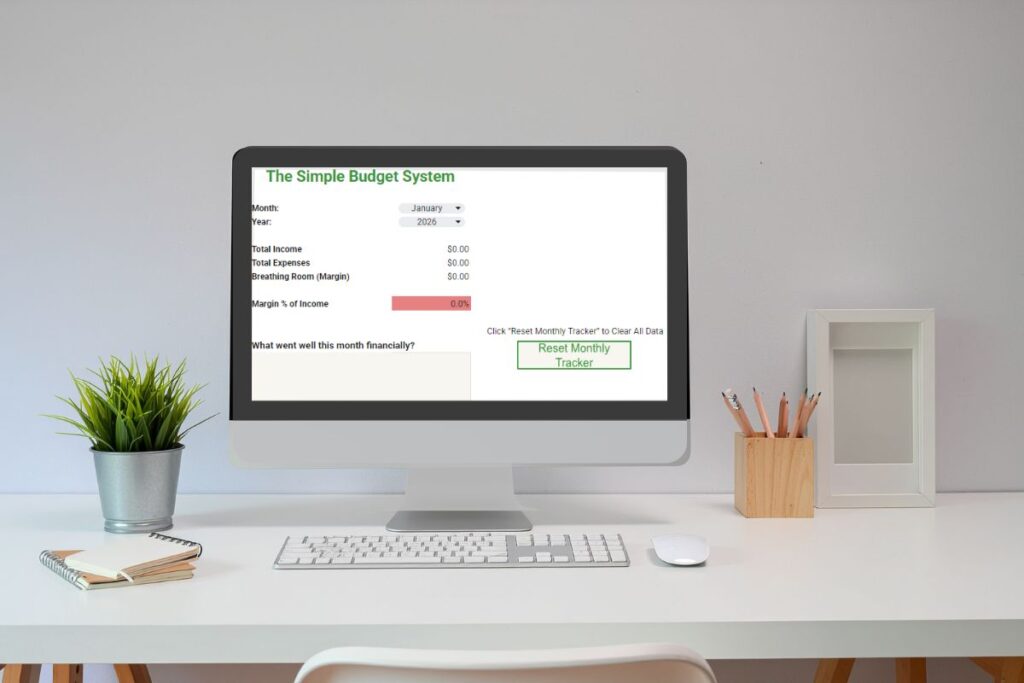
That’s why I created The Simple Budget System.
It’s a clean, guided spreadsheet that walks you through exactly what this article covers — seeing your money clearly, building margin, and reviewing your month without stress. It also includes a short monthly reflection so budgeting doesn’t turn into numbers without meaning.
If you want to follow along using a structure that’s already set up, you can grab it free here:
👉 Get The Simple Budget System (Free)
(Delivered as part of the Earned Future Starter Series.)
This isn’t required. But for many people, having one clear place to budget their money is what turns understanding into action.
A Simple Tool That Helps You Stay Consistent
One reason budgeting falls apart is that everything stays mental. Decisions feel easy to postpone when they don’t live anywhere physical.
Some people find it helpful to use a dedicated planner or notebook for their monthly money check-in. Something simple, structured, and not overwhelming.
A budget-focused planner like the Clever Fox Budget Planner gives your finances a clear, physical place to live, which can make it easier to stay consistent without overthinking the process.
Again — optional. But for many, this small structure makes consistency easier.
A Simple Close
You don’t need a complicated system to budget your money well. You need one that respects your time and attention.
When you step back and see the whole picture, budgeting stops feeling reactive and starts feeling intentional. From there, it becomes easier to automate the things that don’t actually need your attention, which frees up mental space you didn’t realize you were carrying. And when you leave a little room for life — because plans will shift and expenses won’t always behave — your budget becomes something that supports you instead of something you have to constantly manage. As a result, budgeting feels less like a task and more like a steady rhythm you can trust.
That’s how budgeting becomes supportive instead of stressful — and how real financial freedom starts.