
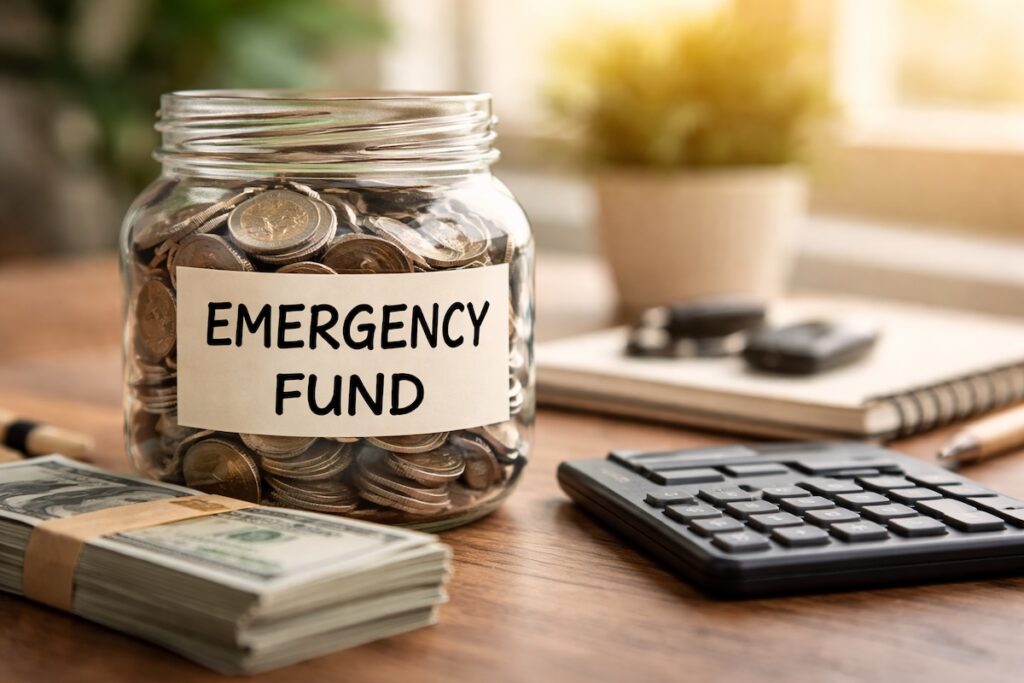
When your income comes in waves instead of a steady line, money feels different. There are seasons when checks land consistently and things feel solid. Then there are slower stretches, delays, or gaps where nothing moves for a while. In those seasons, the purpose of an emergency fund stops being abstract and starts becoming practical.
I’ve lived in both modes.
Earlier in my life, I couldn’t hold onto money for long. I would try to budget, promise myself I’d save something from each check, and still end up spending what felt like “extra” by the end of the week. Credit cards became a bridge between paydays. When the next check arrived, I’d pay the balance down — only to run it back up again before the following one hit.
Nothing dramatic ever collapsed. I always covered what I needed. Still, there was no real buffer underneath any of it.
Cars would break down at the worst time. Fixing them myself often meant losing part of a workday. That lost income wasn’t catastrophic, yet it exposed something important: everything depended on the next check landing exactly when it should.
Over time, especially as my work became more seasonal and income arrived in heavier stretches followed by quieter ones, that fragility became obvious. I didn’t need better discipline. I needed separation between volatility and consequence.
That’s when the purpose of an emergency fund stopped being theoretical and started becoming structural.
Why the Purpose of an Emergency Fund Gets Blurry
Many people never build one because they don’t fully define its role. If you’ve read Why Most Emergency Funds Never Get Built, you’ve seen how delay often starts with confusion. When the purpose isn’t clear, saving feels optional.
Part of the confusion comes from how we describe it. We say it provides peace of mind. We call it security. Those are benefits, but they don’t explain function.
The purpose of an emergency fund is not emotional comfort. It is structural stability.
Once you understand that, everything else starts to make sense.
The Purpose of an Emergency Fund Is Stability
At its core, the purpose of an emergency fund is to stabilize your money when income or expenses shift unexpectedly.
It is not designed to grow wealth. It does not exist to outperform investments or optimize returns. Instead, it sits between volatility and consequence.
During my contract cycles, I realized something simple. The months I had cash set aside felt different. When a check was delayed or a contract ended, I didn’t panic. Bills still had to be paid, yet I had time. That time changed everything.
Without a buffer, timing controls you. With one, you regain control over timing.
That’s the role it plays inside the system, even if it doesn’t feel dramatic.
Growth and Protection Play Different Roles
Money systems need growth, but they also need protection. Trouble begins when those roles blur.
Investments exist to compound over time. They accept risk in exchange for potential return. An emergency fund does the opposite. It accepts lower growth in exchange for reliability.
When markets drop, it remains steady. If income shifts, access does not disappear. Even when timing changes, availability stays intact.
Growth pushes you forward. Protection keeps you upright.
Comparing the two misses the point.
What the Purpose of an Emergency Fund Is Not
Understanding limits protects the structure.
An emergency fund is not for predictable expenses. Annual insurance, routine maintenance, or planned travel belong elsewhere. Those costs may be irregular, but they are not surprises.
It also is not a lifestyle cushion. Overspending in a category does not convert into an emergency simply because it feels uncomfortable.
When I was younger, I treated every extra dollar like opportunity. That habit meant I never built a real stabilizer. I had cash flowing through my hands, yet nothing absorbing shocks. As a result, every repair or delay forced me to adjust somewhere else.
The purpose of an emergency fund is to prevent that chain reaction.
Timing Gaps Are the Real Stressor
Most financial stress does not come from catastrophe. It comes from timing.

Paychecks land on certain days. Bills leave on others. Contracts end. Repairs demand immediate attention. Although each event seems manageable alone, together they create pressure when no buffer exists.
I learned this the hard way. Losing half a day of work to fix a car might not seem like much. However, when money already feels tight, even small interruptions ripple outward.
An emergency fund absorbs that ripple. Instead of pulling from a credit card or scrambling for the next check, you bridge the gap calmly.
That’s what stability feels like in real life — not perfect, just steady.
Income Interruption Changes the Equation
Contract work makes one thing obvious: income is not permanent.
When a job ends, it does not matter how responsible you were the month before. Bills continue. Expenses remain. Without protection, long-term plans suffer.
Earlier in my life, I relied on momentum. As long as checks kept coming, everything worked. Once that rhythm broke, I felt exposed.
Over time, I stopped thinking of emergency savings as “extra money” and started seeing it as structural separation. It created space between volatility and long-term assets. Because of that separation, I didn’t have to liquidate investments or rely on credit the moment work paused.
Time opened up. Pressure decreased. Decisions improved.
That separation is really what the purpose of an emergency fund comes down to.
Where It Fits Inside a Money System
Think of your money system as layered.

Income flows in.
Expenses flow out.
Growth assets compound.
Protection layers stabilize.
The emergency fund belongs between income volatility and everything else.
Without it, disruption reaches directly into daily cash flow or long-term investments. With it, disruption stops early.
This layering principle also explains why systems built purely on attention often break down. If you’ve read Why Your Budget Works at First — Then Slowly Breaks Down, you’ve seen how fragile systems feel when they depend too heavily on constant focus. Protection reduces that fragility.
Layered systems last because they expect imperfection.
Why Stability Feels Underrated
Growth looks productive. Stability looks quiet.
You can measure returns easily. You rarely measure the problems that never happened because you were prepared.
When I finally built a real buffer during contract seasons, nothing dramatic changed. There was no visible win. However, stress dropped. Decisions slowed down. I stopped reacting to timing shifts.
That quiet stability allowed growth to continue without interruption.
The purpose of an emergency fund is not acceleration. It is sustainability.
Before You Think About Amounts
We are not calculating how much to hold or where to keep it yet. Execution comes later.
First, define the role.
Instead of listing functions, think of it this way: when timing shifts, when income pauses, or when something unexpected demands attention, this layer steps in so the rest of your system doesn’t have to bend.
Once that definition is clear, later decisions become logical instead of arbitrary.
And when you understand what this fund is designed to handle, it becomes easier to separate true emergencies from expected irregular expenses.
That distinction leads directly to the next step: Emergency Fund vs Sinking Funds — and why keeping those roles separate protects the entire system.