
There’s a point where things start to feel better, and you begin to wonder how to stay consistent with your energy without slipping back into the same cycle again. You’re not as drained as before, and you understand your limits more clearly, but something still feels fragile. The progress is there, yet it doesn’t feel fully stable. A few busy days pass, small habits fall away, and your energy dips just enough to notice. Not dramatically, but enough to make you question why it doesn’t quite hold.
This is where most people get stuck. Not in the exhaustion itself, but in the space after it—when things are improving, but not yet steady.
Why progress fades more quietly than expected
When your energy starts to return, it’s natural to loosen up a little. You stop watching your limits as closely, you take on a bit more, and you rely more on how you feel in the moment instead of the small structures that were helping. None of this feels like a mistake, and in isolation, it isn’t. But over time, those small shifts begin to stack.
You might stay up a little later than usual, skip the short pause that helped you transition out of work, or let your evenings fill back up without noticing. Nothing feels extreme, but the consistency that was supporting your energy slowly fades into the background. Without realizing it, you’re relying on motivation again instead of something steadier.
That’s where it becomes harder to stay consistent with your energy, because everything starts depending on how you feel that day.
Why it’s hard to stay consistent with your energy over time
When your energy dips again, the instinct is to reset everything. You tell yourself you’ll get back on track, rebuild your routine, and do it right this time. It feels productive in the moment, like you’re taking control again, but this is where a subtle cycle forms.
You feel tired, you fix things, you feel better, you drift, and then you repeat the process. Over time, the reset itself becomes the system. Each time your energy drops, you respond by rebuilding instead of maintaining, and that rebuilding takes more effort than it seems.
The problem isn’t that you’re trying to improve. It’s that your progress depends on starting over instead of holding steady. And when everything depends on resetting, your energy is always tied to effort instead of consistency.
Shifting from improvement to stability
At some point, the goal has to change from feeling better to staying steady. That shift is quieter than most people expect, but it makes everything easier to maintain.
Stable energy doesn’t mean you feel great all the time. It means your days feel more even. There are fewer spikes where you push too hard and fewer crashes where everything drops at once. You’re not constantly adjusting, fixing, or reacting to how you feel.
What really changes is the number of decisions you have to make. If your energy depends on constant awareness, you’re always checking in, correcting, and trying to get it right. But with something steadier supporting you in the background, you stop needing to think about it so much.
When recovery is missing, even good sleep can still leave your energy feeling unstable — something we talked about in Why You Never Feel Rested.
And once that shift happens, it becomes much easier to stay consistent with your energy without constant adjustments.

A simpler way to stay consistent with your energy
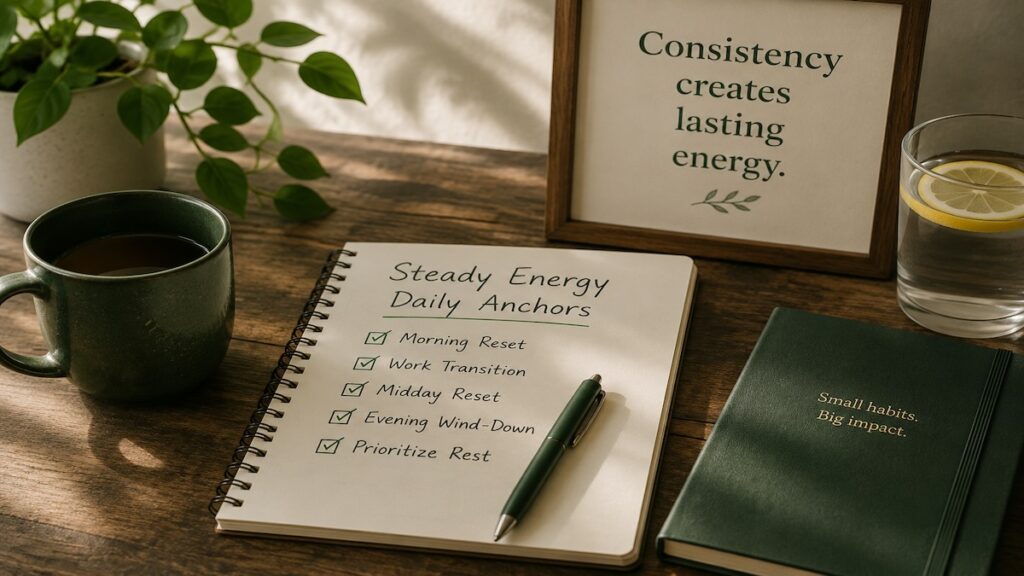
Instead of building a full routine or trying to optimize everything, it helps to think in terms of small anchors—points in your day that stay consistent even when everything else shifts.
These anchors don’t need to be impressive. In fact, they work best when they’re simple enough that you barely notice them.
One example is a short transition after work. Rather than moving straight into the next part of your day, you give yourself a few minutes where nothing is required. It could be sitting quietly, stepping outside, or just pausing before doing anything else. The action itself isn’t important. What matters is that it creates a clear break, so your day doesn’t blur together.
Another anchor might be a consistent signal that your evening is slowing down. Not a full routine, but a small action that happens often enough to cue your body that things are winding down. Turning off a certain light, closing your laptop at the same point each night, or making a cup of tea can all serve as that signal. Over time, those small cues reduce the need to decide when to stop, because the decision is already built in.
Even something as simple as a short reset in the middle of your day can make a difference. A brief walk, a glass of water, or a moment to clear a surface can help your energy settle before it dips too far. These moments don’t need to fix anything. They just give your system space to recalibrate.
If you’ve ever noticed how a short pause can reset your focus, you’ve already seen this effect in action.
Why small anchors make it easier to stay consistent with your energy
The value of these anchors isn’t in the action itself. It’s in what they remove.
When you rely on decisions, you’re constantly asking yourself whether you need to rest, slow down, or adjust your day. That ongoing mental loop uses energy on its own, which makes it harder to stay consistent over time.
Anchors reduce that loop by turning decisions into defaults. Instead of asking what you should do, you follow something that’s already built into your day.
This is the same principle behind habit stacking, where small actions are attached to things you already do so they happen naturally instead of requiring effort.
Because these anchors are small and predictable, they continue even on days when your energy is lower. That’s what allows them to hold over time, instead of falling apart the moment things get busy.
Letting systems carry the weight
One of the biggest shifts comes when you stop expecting yourself to manage your energy all day long. That kind of constant awareness isn’t sustainable, even if it works for a while.
What lasts is something quieter. A few small structures that continue working in the background, whether you’re thinking about them or not.
This is also why consistency in general becomes easier when the system doesn’t rely on attention alone — something we explore more in Staying Consistent. When something is simple enough to repeat, it stays in place without needing to be rebuilt.
Over time, those small pieces start to carry more of the load. You don’t feel like you’re maintaining everything manually, and your energy stops depending on how focused or motivated you are that day.
What this actually feels like
Most days won’t feel perfect, and they don’t need to. You’ll still have moments where you do too much or forget the small things that help. The difference is that you no longer need to reset everything when that happens.
Instead, you return to the same small anchors that were already there. You pause after work, or you follow your usual wind-down signal, or you take a short reset in the middle of your day. These moments are easy to step back into, because they never required much effort to begin with.
That’s what makes them sustainable. They don’t depend on you having a perfect day. They just need to happen often enough to keep your energy from drifting too far.
A steady way forward
Staying consistent with your energy isn’t about doing more or building something more complex. Most of the time, it’s about removing the friction that makes consistency hard in the first place.
When there are fewer decisions to make, fewer resets to rely on, and fewer moments where everything depends on how you feel, your energy starts to level out on its own. It won’t be perfect, but it will be steadier.
And that steadiness is what lasts.
Over time, your days begin to feel more even, your energy becomes more predictable, and you stop feeling like you need to fix things all over again. The progress you’ve already made starts to hold, not because you’re pushing harder, but because you’ve made it easier to stay where you are.
You’re not forcing consistency—you’re creating a way to stay consistent with your energy that holds, even on imperfect days.