
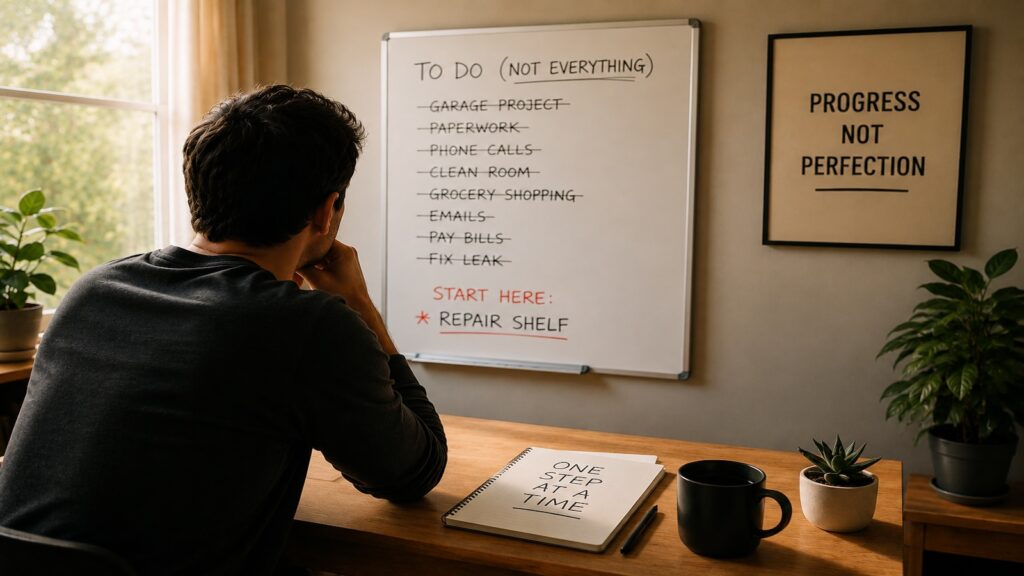
You finally have time to start moving again, but something still feels stuck.
The weekend arrives. The workday ends. The obligations that felt urgent a few days ago are sitting right in front of you.
You know what needs to be done. You probably even want to make progress.
Yet somehow, you still can’t seem to begin.
If you’ve read Why You Avoid Important Things Even When You Have Time and Why Motivation Feels Powerful at First — Then Stops Working, you already know this isn’t necessarily laziness and it isn’t always a motivation problem. Sometimes the real challenge is figuring out how to start moving again when the weight of everything feels bigger than any single task.
I’ve experienced this myself after coming home from work assignments that keep me away for weeks at a time. There’s usually a list waiting for me when I get back. Projects around the house. Repairs I’ve been meaning to finish. Small things that quietly piled up while I was gone.
At first, progress comes easily. The obvious tasks disappear quickly. Then the remaining projects start feeling heavier. Instead of seeing one next step, I start seeing everything that’s left. The list gets louder, the pressure grows, and before long I’m spending more time thinking about the projects than actually working on them.
That’s the trap overwhelm creates.
The good news is that most people don’t need more motivation to escape it. More often, they need a smaller place to begin.
Why It’s Hard to Start Moving Again
When people feel overwhelmed, they often assume the problem is the amount of work in front of them.
Sometimes that’s true. More often, though, the real problem is the amount of mental weight attached to that work.
A project that might take thirty minutes can feel impossible after weeks of postponing it. Not because the task changed, but because the story surrounding it grew larger. Now it represents unfinished responsibilities, lingering guilt, and every other thing competing for your attention.
The longer that pressure builds, the harder it becomes to see a clear starting point.
This is why overwhelm feels so different from being busy. When you’re busy, you may have a lot to do, but the next step is usually obvious. When you’re overwhelmed, everything starts blending together. Every task feels equally important. Every responsibility feels unfinished. Your brain tries to hold the entire list at once, and the result is often paralysis rather than action.
The strange part is that the work itself usually hasn’t grown very much.
What grows is the mental load.
That’s why people can spend an hour worrying about a task that only takes fifteen minutes to complete. The resistance surrounding the work becomes larger than the work itself.
The Problem With Looking At Everything At Once
One of the hardest parts of overwhelm is that it convinces you everything needs your attention right now.
The unfinished project in the garage sits next to the paperwork you’ve been putting off. That paperwork sits next to the phone call you need to make, the room you wanted to clean, and the dozen other things quietly waiting in the background. When your brain sees all of it at once, it stops seeing individual tasks and starts seeing one giant problem.
That’s usually when progress stalls.
The mind is remarkably good at creating mental inventories. It can hold dozens of unfinished responsibilities and replay them throughout the day. What it struggles to do is make sense of all those responsibilities at the same time. Instead of choosing a starting point, you start evaluating everything.
I’ve noticed the same thing when I come home from being away for work. The easy projects get finished first, but the remaining ones require more thought, more time, or more decisions. If I spend too much time looking at everything that’s left, it becomes surprisingly difficult to decide what to work on next.
The workload itself often hasn’t changed very much. What’s changed is that I’m trying to carry the weight of the entire list at once. That’s when overwhelm grows and action starts feeling harder than it really is.
Momentum Returns After You Start Moving Again
One reason people stay stuck is that they assume motivation should arrive before action.
That sounds reasonable, but most of us have enough life experience to know it doesn’t always work that way. The motivation we remember from the beginning of a project is often the result of movement, not the cause of it. Once we’re engaged with something, progress creates energy. Before we’re engaged, all we can see is the effort required to begin.
Think about the last task you avoided for weeks and then finally completed. The task itself may not have been enjoyable, but there’s a good chance it felt easier once you actually started. The resistance leading up to the task was often larger than the task itself.
I’ve noticed the same pattern with projects around the house. The days when I make the most progress aren’t necessarily the days when I feel the most motivated. They’re usually the days when I start before I’ve had time to overthink everything that’s left to do. Once one project is moving, the next decision tends to feel easier. Not because the work changed, but because movement creates clarity that sitting and thinking rarely provides.
This is why it’s so important to remember that motivation doesn’t always lead to action. Quite often, action is what allows motivation to return.
A Smaller Way to Start Moving Again
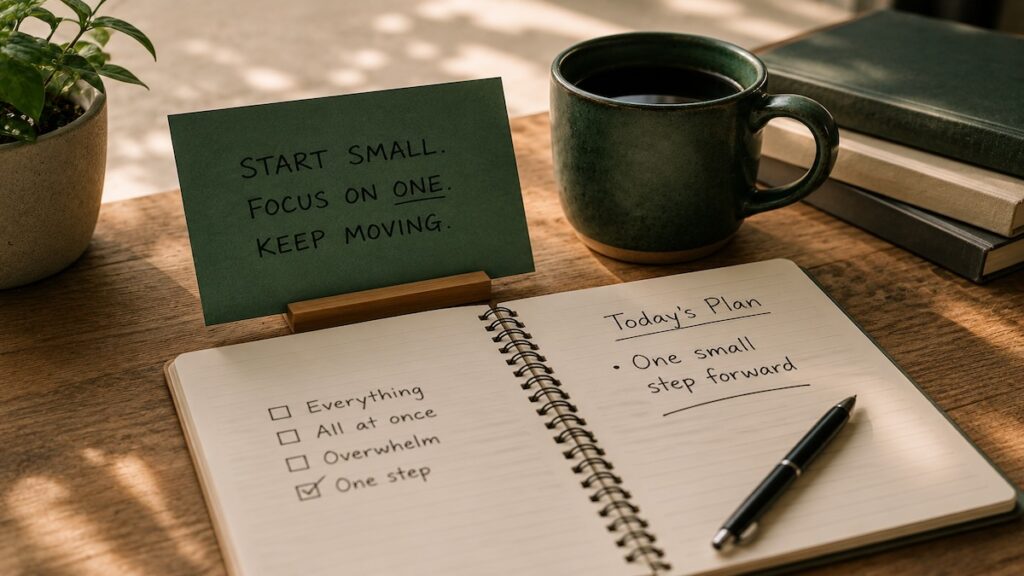
When everything feels overwhelming, the natural instinct is to focus on the finish line.
You think about completing the project, clearing the list, organizing the room, finishing the repair, or finally getting caught up. The problem is that large finish lines create large amounts of pressure. The bigger the outcome feels, the more intimidating the first step becomes.
A more useful question is often much smaller.
Instead of asking how you’ll finish everything, ask what would make beginning easier.
Once you’ve chosen a starting point, give yourself permission to stay there for a while. One reason people remain overwhelmed is that they keep returning to the full list before they’ve given themselves a chance to see progress. They start one task, remember three others, and immediately begin evaluating everything again.
Movement becomes easier when you stay with one thing long enough to see it move forward. You don’t need to ignore the rest of your responsibilities forever. You simply need to stop asking all of them for attention at the same time.
Sometimes that means opening the document instead of writing the report. It could mean gathering the tools instead of completing the repair. Sometimes it means clearing one section of a room instead of trying to transform the entire space in a single afternoon.
The goal isn’t to trick yourself into being productive. It’s to lower the amount of resistance standing between you and the first action. Once movement begins, the next step usually becomes easier to see because you’re no longer trying to solve the entire problem from the starting line.
Separate Progress From Completion
Many people accidentally make overwhelm worse because they only count finished results.
If the project isn’t complete, they assume they haven’t accomplished anything meaningful. That mindset creates a lot of unnecessary pressure, especially when the things you’re working on naturally take time.
I run into this with larger projects around the house. Some can be finished in an afternoon. Others stretch across multiple weekends because there are materials to buy, decisions to make, or other priorities competing for attention. If I only counted the finished projects, it would often feel like nothing was happening.
But progress rarely works that way.
Researching a solution is progress. Gathering materials is progress. Spending thirty focused minutes moving something forward is progress. None of those things produce a finished result, but they all make the eventual result easier to reach.
This is one reason small wins matter so much. They provide visible proof that movement is happening even before completion arrives. When you learn to separate progress from completion, the pressure begins to ease because you stop measuring success entirely by the finish line.
Instead, you start noticing whether you’re moving forward.
What To Do When You Still Don’t Feel Ready
There will be times when none of this immediately changes how you feel.
You’ll understand the logic, agree with the ideas, and still feel resistance.
That’s normal.
Most people spend a lot of time waiting to feel ready because readiness feels safer than uncertainty. The problem is that certainty rarely arrives before action. There will always be reasons to postpone a difficult conversation, a lingering project, or a responsibility you’ve been avoiding.
Rather than trying to eliminate uncertainty, it helps to lower the expectations surrounding the first step. You don’t need confidence that you’ll finish everything or have a perfect plan. You don’t even need proof that you’ll stay motivated for the next month.
The only thing you need is enough willingness to begin.
In many cases, one imperfect step creates more clarity than another hour spent thinking about the perfect approach. The first action doesn’t need to solve the entire problem. It only needs to make tomorrow slightly easier than today.
When everything feels overwhelming, the goal isn’t to solve your entire life in an afternoon. It’s to reduce the weight enough to begin moving again.
Most of the time, momentum doesn’t arrive first. It shows up after the first few steps. Once movement returns, things that felt impossible often start looking manageable again—not because your responsibilities disappeared, but because you’re no longer carrying all of them at once.
Learning how to start moving again matters. The next challenge is making sure overwhelm does not quietly build back up over time. That is where small maintenance habits help. In the next article, How to Keep Life From Piling Up Again, we’ll look at how to create simple reset points that keep small delays, open loops, and unfinished tasks from turning into one giant reset.