
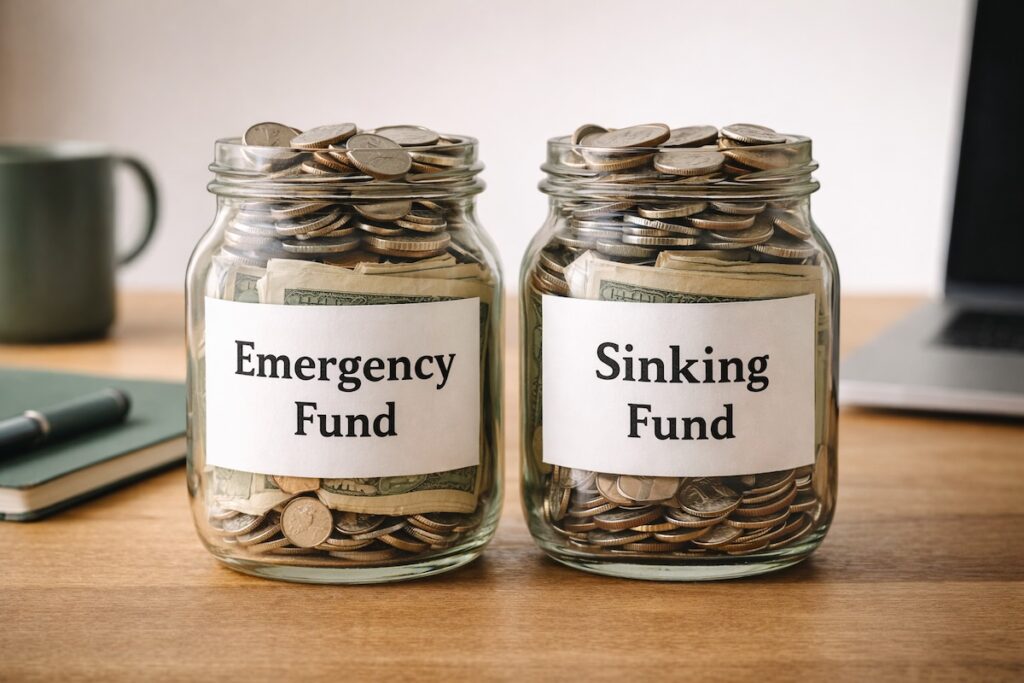
Most people don’t realize there’s a structural gap in how they save. That’s where the emergency fund vs sinking funds difference becomes clear.
However, they do very different jobs.
When those roles get mixed, money never quite feels steady. You can earn well and save often, yet still feel like you’re starting over every few months. That frustration isn’t about willpower. It comes from how the money is set up.
When I was younger, I had one savings account for everything. It covered emergencies, vacations, shortfalls — whatever came up. At first, that seemed simple. In reality, it meant the balance was always moving. Nothing major happened. Still, the account never felt secure because it didn’t have a clear job.
That confusion sits at the center of the emergency fund vs sinking funds issue.
Emergency Fund vs Sinking Funds: Why the Line Gets Blurry
Most people open a savings account and label it “emergency.” That sounds smart.
Then normal life happens.
The car needs tires. Insurance renews. The water heater fails. A trip gets planned. A laptop dies. Each time, money leaves the same account.
In the moment, every withdrawal feels reasonable. Over time, though, that one bucket carries two very different types of pressure:
• expenses you expect
• events that disrupt your life
Those are not the same thing — one belongs to the normal rhythm of living, while the other throws that rhythm off completely.
When both pull from the same place, the balance never settles.
Predictable Costs Are Not Emergencies
Sinking funds exist for expenses you know will happen — even if you don’t know the exact date. Oil changes, car maintenance, annual subscriptions, holiday travel, home repairs, replacing aging appliances, even property taxes — none of these are true surprises. They may be frustrating. They may cost more than you want. But they are part of normal life.
A real emergency is different. Losing income changes your stability. A medical crisis forces immediate decisions. A sudden major repair or unexpected relocation can shift your entire financial footing. These situations don’t just cost money — they disrupt your life.
One category creates inconvenience. The other creates instability — and that difference matters.
If you’ve already read The Real Purpose of an Emergency Fund, you know its job isn’t to handle routine maintenance. Its job is to protect you when stability is at risk.
Put simply:
Sinking funds prepare you for expected costs.
Emergency funds protect you from disruption.

Emergency Fund vs Sinking Funds and Timing
Another way to think about the emergency fund vs sinking funds difference is timing.
Sinking fund expenses build slowly. You can usually see them coming. Emergencies hit fast.
Replacing tires doesn’t change your life. Losing your job does.
Both require money. Only one threatens your foundation.
When expected expenses drain the same account meant for real disruption, protection shrinks quietly. The number in the account looks fine, but it represents maintenance, not safety. That’s when stress creeps in.
What Mixing Them Actually Does
When one account tries to do everything, three things happen.
First, the balance becomes confusing. You can’t tell whether the money is truly available or already spoken for.
Second, rebuilding never ends. You withdraw for something normal. Then you try to build it back up. Then something else hits. The cycle repeats.
Third, real emergencies feel heavier. The cushion exists, but it’s thinner than it should be.
I lived in that pattern for years. The account wasn’t the problem. The setup was. One bucket carried too many roles, so none of them felt solid.
The stress didn’t come from spending. It came from unclear structure.
What Changes When You Separate Them
Once you clearly separate emergency funds and sinking funds, the pressure drops.
Predictable costs get their own space. You add to them slowly. When the expense arrives, you use the money without guilt.
Meanwhile, the emergency fund stays untouched unless something truly disruptive happens, and that separation quietly reduces the pressure you feel.
Instead of wondering whether you “broke” your emergency fund, you know exactly what it’s for. Instead of constantly rebuilding, you fund each role on purpose.
Defined jobs make money feel steadier — even before the balances grow.
why Structure Comes Before Size
Many people jump straight to one question: how big should an emergency fund be?
That question matters. However, size only works once the structure is clear.
If predictable costs keep draining the same account, any target will feel unstable. You’ll either oversave out of fear or feel behind all the time.
Separation is what makes later decisions stable.
After that, the math gets simpler. You calculate protection based on risk, not routine maintenance.
In the next article, How Much Emergency Fund You Actually Need, we’ll walk through that calculation step by step.
For now, focus on clarity.
Once you separate what is predictable from what is disruptive, deciding how much protection you need becomes far more logical.