
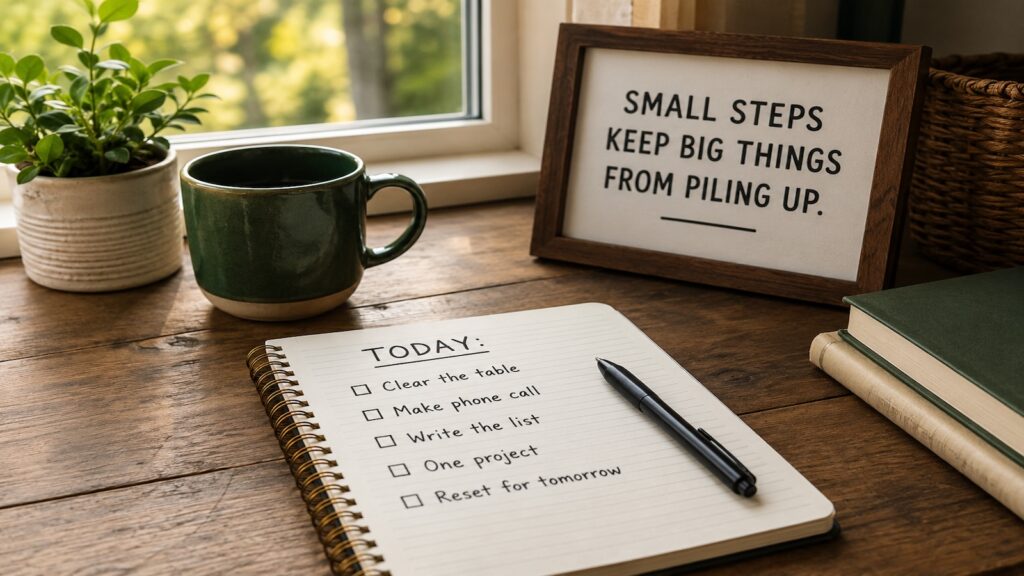
Learning how to keep life from piling up is different from learning how to start again after everything already feels overwhelming.
Starting again matters. Sometimes that first small step is what breaks the pressure and reminds you that progress is still possible. If you just read How to Start Moving Again When Everything Feels Overwhelming, you already know that action does not have to begin with a perfect plan or a huge burst of motivation. Sometimes it begins by making the next step small enough to take.
But starting again is only one part of the cycle.
The harder part is what happens afterward.
Because once you finally create movement, life keeps moving too. Work gets busy again. Small tasks return. The house needs attention. Appointments need to be scheduled. Repairs wait longer than you meant them to. One skipped reset becomes two, then three, and before long the pressure that finally eased starts quietly building again.
That is usually how overwhelm returns.
Not all at once.
It piles up slowly.
The goal is not to build a perfect routine that catches everything before it becomes a problem. That would just create another kind of pressure. Instead, the aim is to notice the small buildup earlier, reduce the amount you are carrying mentally, and create a few simple habits that keep life from turning into one giant reset.
Why Life Starts Piling Up Again
Most people do not fall behind because they stop caring.
More often, life starts piling up because small things are easy to delay when they do not feel urgent yet. A dish gets left in the sink. A piece of mail stays unopened. A repair gets pushed to next weekend. A decision sits in your head instead of getting written down somewhere useful.
None of these things feels like a big deal by itself.
That is why they are so easy to ignore.
Delayed things do not always disappear quietly. Many of them stay active in the background of your mind, showing up while you are trying to focus on something else. You remember the task in the middle of another responsibility, notice it again when you walk into the room, tell yourself you should deal with it soon, and then move on because something else feels more immediate.
Over time, the work itself becomes only part of the problem. The other part is the constant awareness that the work still exists.
I notice this most when I come home from being away for work. At first, I usually have the energy to catch up. I handle the obvious things, clean up what is easiest, and knock out a few quick wins. Then normal life starts again. The remaining projects are less simple, less exciting, and easier to postpone.
That is when things start piling up again.
Not because everything is falling apart, but because unfinished things are quietly collecting faster than I am clearing them. That is where learning how to keep life from piling up starts to matter.
The Goal Isn’t To Stay Perfectly Caught Up
This is where it is easy to aim for the wrong thing.
When life feels messy, the instinct is to want a clean slate. You want every task finished, every room reset, every project handled, and every loose end closed. That sounds peaceful, but it can also become unrealistic fast.
Most real lives do not stay perfectly caught up.
There will always be something waiting. A closet that could be cleaned out. A message that needs a reply. A task that can wait but should not wait forever. Maintenance is not about eliminating every unfinished thing from your life. It is about keeping the unfinished things from becoming so heavy that you stop knowing where to begin.
That distinction matters.
If the standard is perfection, then the moment something slips, the whole system feels broken. But if the standard is reducing drift, you have more room to work with. A few things can be unfinished without becoming a crisis. A room can be imperfect without turning into a problem. A task can wait as long as it has not disappeared completely from view.
This is also why motivation is not a strong enough maintenance plan. As we talked about in Why Motivation Feels Powerful at First — Then Stops Working, motivation is useful at the beginning, but it is not something you can depend on forever. Maintenance has to be quieter than that. It has to work even when the excitement is gone. A quieter system is what helps keep life from piling up once the early energy fades.
The goal is not to depend on feeling inspired every day.
The goal is to create a way back before things get too heavy.
How to Keep Life From Piling Up in Small Ways
The best way to keep life from piling up is not usually a dramatic reset. It is a small amount of attention applied more often.
That might sound less satisfying than clearing an entire room, finishing every task, or rebuilding your whole routine in one weekend. But it is also much easier to live with. Big resets feel good when you have the energy for them. Small maintenance habits matter because they help you avoid needing a big reset so often.
This can be as simple as choosing one small daily stopping point.
You might clear one surface before bed.
After dinner, you could reset the kitchen just enough that tomorrow does not start behind.
At the end of the workday, writing down the loose tasks still floating in your head can keep you from trusting your memory to carry them overnight.
None of these actions needs to be impressive. In fact, if it feels impressive, it may be too much to repeat consistently. The point is not to overhaul your environment. The point is to interrupt the buildup while it is still small.
This is where Habit Stacking fits naturally. If you already have something that happens every day, such as making coffee, shutting your laptop, brushing your teeth, or plugging in your phone, you can attach one small reset to that moment. You are not creating a brand-new routine from nothing. You are giving one small maintenance habit a place to live.
That is what makes it easier to repeat.
If you want to keep life from piling up, you create small points in the day where things get a chance to settle before they grow heavier.
Give Open Loops Somewhere to Land
A lot of overwhelm comes from trying to remember too many unfinished things at once.
You may not be actively working on every task, but your mind keeps checking on them. Did I schedule that appointment? Did I ever order the part for that repair? What was I supposed to remember before the weekend? That kind of mental background noise makes life feel heavier than it actually is.
A simple place for open loops can relieve a surprising amount of pressure.
It does not have to be a complicated system. It can be a notebook, a note on your phone, a whiteboard, or one running list that catches anything unfinished. What matters is that your brain trusts the place enough to stop holding everything by itself.
The mistake is trying to organize every open loop the moment you write it down.
Sometimes you just need to catch it first.
Once it is outside your head, you can decide what matters, what can wait, and what no longer needs your attention. That decision is much easier when the task is sitting in front of you instead of floating around in the background.
This is one reason small wins are so useful. Even writing something down can create a tiny sense of movement because it turns vague pressure into something visible. If you have read The Power of Small Wins, you already know how much it helps to create proof that progress is happening, even before everything is finished.
Open loops get heavier when they stay invisible.
Giving them somewhere to land keeps them from becoming part of the mental pile.
This is one of the quietest ways to keep life from piling up, because fewer unfinished things are left floating around in your head.
Use Small Reset Points to Keep Life From Piling Up
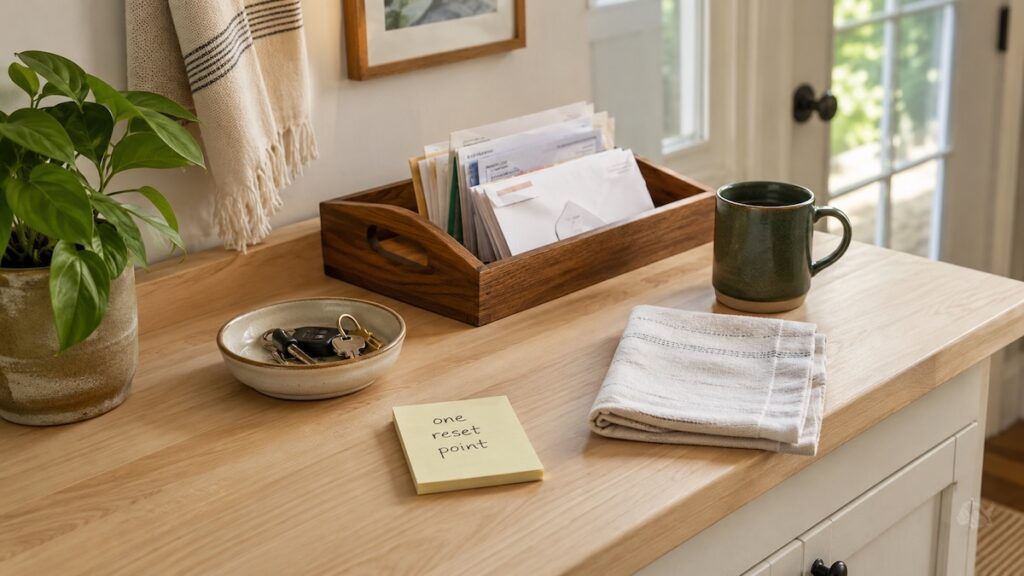
A reset point is not a full reset.
That difference matters.
A full reset usually happens after things already feel out of control. You clean the whole room, catch up on every task, clear the backlog, and try to get back to neutral. There is nothing wrong with that, but it often takes a lot of energy because the pile has already grown.
A reset point is smaller. Instead of waiting until the weight builds too much, you create a brief moment to notice what is starting to drift.
That could mean taking ten minutes on Sunday evening to look at the week ahead. After work, you might spend five minutes putting tools away, clearing the counter, or deciding what needs attention tomorrow. Another reset point could be a quick check-in where you ask, “What is starting to pile up that I can still handle while it is small?”
That question is useful because it does not demand perfection.
It simply creates awareness.
You are not asking yourself to fix your entire life in one sitting. The goal is simply to notice what has started to drift while it is still small enough to handle. It could be laundry, paperwork, a repair that keeps getting pushed back, or a calendar that is quietly filling up with no breathing room.
Catching the drift early makes the next step smaller.
This is also where Staying Consistent connects well. Consistency does not have to mean doing the same big routine every day. Sometimes it means returning to a small reset point often enough that things never become as heavy as they used to.
That kind of consistency is not loud.
It is just maintenance.
Keep Life From Piling Up During Busy Seasons
Busy seasons are where most systems break down.
That is usually because the system was built for normal life, not real life. It works when you have time, energy, and space. Then work gets demanding, travel happens, family needs attention, or your schedule changes, and the whole thing becomes too much to maintain.
The answer is not to try harder during the busiest weeks.
The answer is to shrink the system. That is often the only realistic way to keep life from piling up when your normal routine is not available.
When life is full, maintenance has to get smaller, not disappear completely. You might clear one surface instead of trying to clean the whole house. A large project can move forward one piece at a time, and a crowded inbox can start with the one message that actually matters.
This is especially important if your life moves in seasons. When I am away for work or coming back from a busy stretch, I cannot always maintain the same rhythm I would have during a slower period. If I expect full energy from myself immediately, I usually end up disappointed. A smaller baseline works better because it keeps me connected to the routine without pretending life is normal.
That smaller baseline might not look like much.
But it prevents the complete drop-off that makes everything harder later.
The goal during busy seasons is not to make major progress. It is to keep enough motion alive that re-entry does not feel impossible when life slows down again.
What to Do When Things Pile Up Anyway
Even with good maintenance habits, life will still pile up sometimes.
That does not mean the system failed.
It means you are human, and your life has moving parts.
There will be weeks when the dishes stack up, projects stall, messages go unanswered, and the house starts feeling heavier than you want it to. The difference is how quickly you notice and how gently you restart.
When things pile up again, avoid turning the situation into a character judgment. You do not need to decide that you are lazy, inconsistent, or bad at follow-through. That kind of thinking only adds more weight to what already feels heavy.
Start by reducing the pile back into smaller pieces. Look at what is visible first, then separate what is truly urgent from what is simply annoying. Some things can wait without creating real consequences, and naming that clearly helps lower the pressure.
Once the pile is no longer one giant blur, one next step usually becomes easier to see. You might clear the table, make the phone call, write the list, or choose one project and ignore the rest for an hour.
The goal is not to catch up instantly.
The goal is to restart before the pile becomes your entire focus.
That is the real maintenance skill. It is not about preventing every mess, staying perfectly consistent forever, or becoming the kind of person who never falls behind. It is about noticing sooner, lowering the pressure, and returning to motion before everything feels too big again.
A Calm Close
Learning how to keep life from piling up is not about controlling every detail of your day.
It is about creating enough small points of return to keep life from piling up before it becomes overwhelming. A list can catch what your mind should not have to carry. A tiny reset can stop a room from turning into a project. A smaller baseline can keep you connected during busy seasons when a bigger routine would fall apart.
None of this needs to be dramatic.
In fact, it works better when it is not.
The quiet habits are usually the ones that last because they do not require a special mood to begin. They do not ask you to become a different person. They simply give you a way to notice what is drifting and bring it back a little sooner.
Life will still get messy. Things will still pile up sometimes. You will still have weeks where the system bends more than you want it to.
That is okay.
The goal is not to prevent every pile.
The goal is to keep the pile from becoming so heavy that you forget how to start.
Because life doesn’t stay manageable by accident. It stays manageable through small moments of maintenance that quietly keep tomorrow from becoming harder than today.