
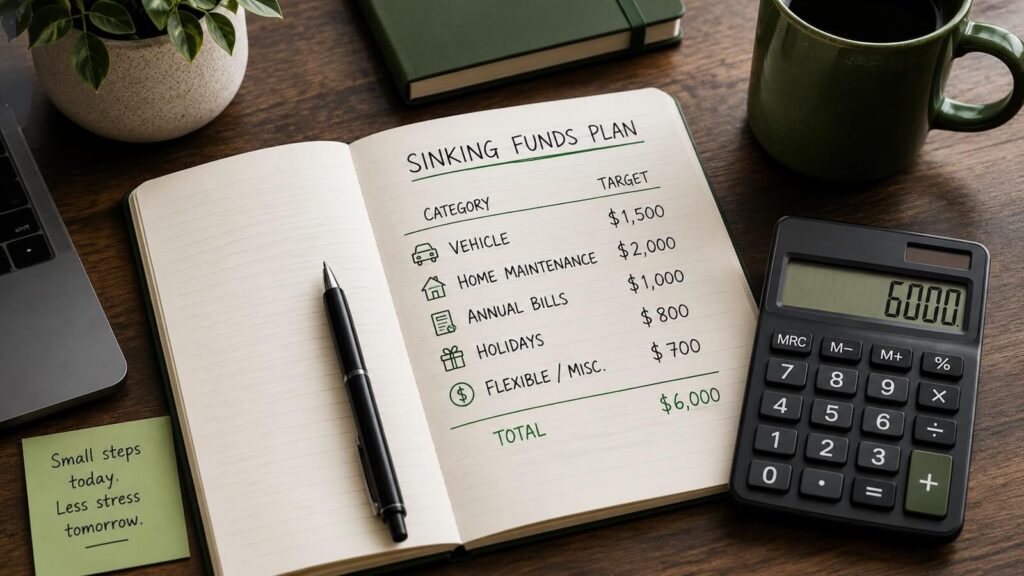
Once you understand the purpose of sinking funds, the next question becomes practical: how do you actually build sinking funds without turning your money into a complicated system you do not want to maintain?
That question matters because sinking funds are usually explained in a way that sounds heavier than the problem they are supposed to solve. People talk about creating a separate account for every future expense, building long lists of categories, and tracking every dollar with perfect precision.
That might work for some people. But for many, it creates the same problem over again: too much structure, too much maintenance, and too many places for the system to fall apart.
The point of sinking funds is not to make your financial life more complicated. It is to give predictable expenses room before they become pressure.
If you have already read The Purpose of Sinking Funds, you know this money is not meant to replace your emergency fund or become another strict budgeting rule. It exists because normal life costs money in uneven ways. Cars need maintenance. Homes need repairs. Insurance renews. Holidays return. Annual bills show up again.
A good sinking fund system simply gives those costs a place to land.
The best way to build sinking funds is not to create the most detailed system. It is the one you will still be using when life gets busy.
Start With the Expenses That Actually Create Pressure
The easiest mistake is trying to build sinking funds for everything at once.
At first, it feels organized. You start listing every possible future cost: birthdays, subscriptions, clothes, pet care, vehicle maintenance, home repairs, taxes, holidays, vacations, appliances, medical costs, and every other expense that could technically happen someday.
Before long, the system becomes too large to trust.
A better starting point is simpler. Look for the expenses that already create pressure in your real life.
For most people, this usually starts with a few broad areas. Vehicle costs are a common one because tires, brakes, repairs, registration, and maintenance rarely arrive at a convenient time. Home maintenance is another because even small repairs can feel stressful when they stack close together. Insurance premiums, property taxes, holidays, and annual bills also belong on the short list because they tend to disrupt cash flow when they are ignored until the month they arrive.
You do not need to capture everything immediately.
You are looking for the costs that keep making your savings feel like it is moving backward.
If a predictable expense regularly forces you to move money around, pause progress, use a credit card, or feel behind, it probably deserves attention. If an expense is small, rare, or easy to handle from normal cash flow, it may not need its own sinking fund yet.
That distinction keeps the system manageable.
You are not trying to predict every future dollar. You are trying to reduce the pressure from the expenses that have already proven they can disrupt your month.
Build Sinking Funds Around Real Life, Not Perfect Categories
A sinking fund category should make your money clearer, not more fragile.
That is why broad categories usually work better than overly specific ones. If the category is too narrow, you have to keep adjusting it. If it is too detailed, the system starts demanding more attention than it deserves.
For example, a “vehicle” sinking fund may be easier to maintain than separate funds for tires, oil changes, registration, brakes, and repairs. A “home maintenance” fund may work better than separate categories for filters, paint, plumbing, appliances, tools, and seasonal upkeep.
The broader category still gives the money a job. It just does not force you to guess every detail before life happens.
That matters because predictable does not always mean exact. You may know your vehicle will need money, but not know whether it will be tires, brakes, or a repair. You may know your house will need attention, but not know which project will matter first.
A useful sinking fund gives that future expense room without asking you to forecast every detail perfectly.
The goal is clarity, not precision.
If you are unsure where to begin, start with three or four broad categories that match the biggest pressure points in your life. For many households, that might be vehicle, home, annual bills, and holidays. Your list may look different, and that is fine. The system should reflect your actual life, not someone else’s template.
This is also why you should avoid building categories just because they sound responsible. If you create a sinking fund for something you do not actually care about, use, or revisit, it becomes noise.
Good money systems stay useful because they match reality.
Where to Build Sinking Funds So They Stay Simple
This is where sinking funds can get overcomplicated quickly.
A lot of people assume they need a separate savings account for every category. That can work if seeing each balance separately helps you stay clear. Some banks also allow labeled buckets inside one account, which can make the system easier to see without opening several accounts.
But separate accounts are not required.
You can build sinking funds inside one high-yield savings account, track them in a spreadsheet, use a simple note, or write them in a notebook and update it occasionally. The account is only the container. The job is the system.
For example, imagine you have $10,000 in one savings account. The bank may show one balance, but your system can see different jobs.
Of that balance, $6,000 might be your emergency fund. Another $1,500 may be waiting for vehicle and home maintenance. Annual insurance and subscriptions might account for $1,000, while $800 is set aside for holidays and the rest remains flexible cash.
You do not necessarily need separate accounts to make that work. You just need a simple way to remember that the full balance is not all doing the same thing.
Others may need more separation because one large balance feels too available. In that case, labeled buckets or separate accounts may reduce stress.
Neither approach is automatically better.
The right structure is the one that tells the truth without creating too much maintenance. If one account keeps things simple and clear, use one account. If labeled buckets make the money easier to respect, use buckets.
Just do not confuse complexity with control.
A sinking fund system should make decisions easier, not give you another financial chore to manage.
How to Build Sinking Funds Without Overthinking It
The simplest way to build sinking funds is to start with the expenses you know are coming and work backward gently.
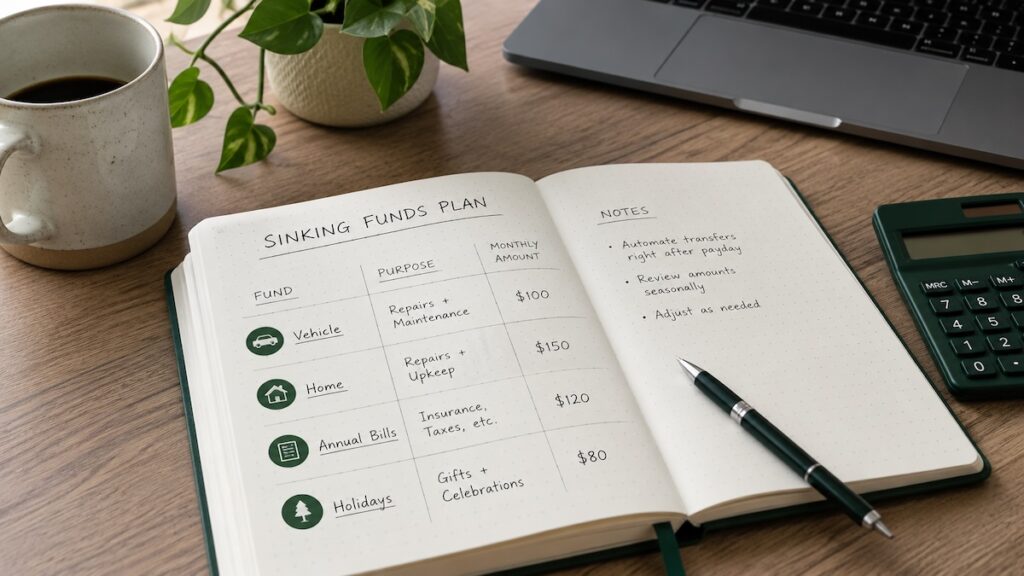
You do not need perfect numbers. You only need a reasonable estimate.
If car insurance costs around $1,200 per year, setting aside about $100 per month gives that bill a place before it arrives. A $900 Christmas season becomes easier to handle when $75 has been building each month instead of waiting for December. For home maintenance, where the exact cost is harder to predict, you might choose a flat monthly amount and let it build.
The basic idea is simple:
Expected cost ÷ months until needed = monthly amount.
But the system does not have to be exact to be useful.
If the number feels too high, start smaller. Saving $40 per month toward a future car repair is still better than saving nothing and acting surprised when the repair shows up. Setting aside $25 per month for holidays still softens December, even if it does not cover everything.
The goal is not to fully fund every future expense immediately.
The goal is to reduce the shock.
That mindset matters because people often abandon sinking funds when the perfect number feels too far away. But normal life does not require perfect preparation to feel better.
A $600 repair feels different when $300 is already waiting for it. An annual bill feels different when half of it is already covered. A holiday season feels different when some of the money has been building quietly for months.
That is how sinking funds begin to work. Not by making expenses disappear, but by making them less disruptive.
Keep the First Version Small
The first time you build sinking funds, the system should probably feel almost too simple.
That is a good thing.
A small system gives you a chance to learn what actually needs attention before you add more structure. If you begin with fifteen categories, you may spend more time maintaining the system than benefiting from it. If you begin with three or four, you can see what works without feeling buried.
A simple first version might include vehicle costs, home maintenance, annual bills, and holidays or seasonal spending.
That is enough to start.
Over time, something else may earn its own place. Medical expenses, pet costs, school expenses, or travel might eventually need more attention. But they do not all need to be included on day one.
Do not start by trying to build the final version.
Start with the version you can actually use next month.
A complicated system can look impressive when you first create it. A simple system proves itself when you are still using it six months later.
Build Sinking Funds You Can Return To
A sinking fund system should be easy to come back to after life gets busy.
That matters because even good systems get ignored sometimes. You may go through a busy season, forget to update a category, use the money for something expected, or realize one of your original estimates was off. None of that means the system failed. It just means the system needs to be simple enough that returning to it does not feel like starting over.
You do not need to check your sinking funds every day. In most cases, a monthly or quarterly look is enough. The point is not to micromanage every category. It is simply to notice whether the money still matches the expenses it is supposed to handle.
A simple review might mean looking at what expenses are coming up, seeing whether any category feels too low, and deciding whether something needs to be adjusted. If a category no longer serves a clear purpose, remove it. Smaller categories can be combined when they are too hard to manage separately, while a broad category can be split later if it keeps creating confusion.
That is normal.
A useful system is allowed to change because real life changes. The goal is not to build sinking funds perfectly on the first try. The goal is to build them in a way you can keep returning to without feeling buried by the system itself.
You are not trying to watch every dollar move. You are making sure each pool of money still has a clear job.
A Calm Close
Learning how to build sinking funds is not about creating a complicated savings system.
It is about giving normal life enough room to happen.
Cars will need maintenance. Homes will need repairs. Holidays will return. Annual bills will come due. Some expenses will be predictable without being perfectly exact, and that is exactly why a simple sinking fund system helps.
You do not need to get every category right on the first try. Separate accounts are not required for every possible future cost. Exact amounts do not have to be known months ahead of time.
The important part is giving expected expenses a place before they become pressure.
When the system is simple enough to use, sinking funds stop feeling like another financial task and start feeling like quiet protection. Cash flow becomes steadier. Your emergency fund stays protected. Your savings balance feels more honest. Over time, normal life stops interrupting the progress you are trying to build.
The next step is learning how to keep that system useful as real life changes around it. Categories, priorities, income, and expenses will shift over time, and a good sinking fund system should be able to shift with them without becoming complicated.
In How to Keep Sinking Funds Simple as Life Changes, we’ll look at how to adjust categories, update amounts, rebuild after using the money, and keep the system clear enough to keep using.