

Most people do not think much about their checking account balance until something feels off.
Sometimes the balance feels too low, so every bill creates stress. Other times, the balance grows higher than it needs to be, but the extra money has no clear job. It sits there looking useful, even though it may be doing very little.
That is where checking accounts can get confusing.
A checking account is easy to treat like the center of your financial life because money moves through it constantly. Paychecks land there. Bills come out. Groceries, gas, subscriptions, and automatic payments all touch it in some way. Because of that, it can start to feel like all your cash belongs there.
But your checking account should not be where all your money lives.
Your checking account balance should be large enough to keep your month running smoothly, but not so large that money with a better job sits idle without purpose. The goal is not to keep as much money in checking as possible. The goal is to keep enough money there to support your real life while giving the rest of your cash a clearer role.
Why Your Checking Account Balance Matters
Your checking account is the working part of your money system.
Your checking account is the part of your money system that handles movement. Paychecks land there, bills leave from there, and everyday spending happens in between. When the balance is too thin, normal life starts feeling tense because every transaction depends on timing. Bills feel harder to trust, and you may find yourself checking the account just to make sure everything clears before the next paycheck arrives.
That kind of stress is exhausting because it turns ordinary money movement into constant monitoring.
But the opposite problem happens too.
A high balance can create a different kind of confusion. Extra money may look available simply because it is sitting in one visible pile, even when part of it is already needed for bills, upcoming expenses, emergency savings, or longer-term goals.
When all of it sits together, the balance looks simple, but the meaning gets blurry.
That is why the number matters. Not because there is one perfect checking account balance for everyone, but because your checking account needs a clear job. Once you know what that account is supposed to do, it becomes much easier to decide how much belongs there.
What Your Checking Account Balance Should Cover
A good checking account balance starts with the account’s actual job.
For most people, checking should cover three things: near-term bills, everyday spending, and a small buffer for timing issues. That is it.
Near-term bills are the expenses that need to clear soon. Rent or mortgage, utilities, insurance, phone bills, loan payments, and subscriptions all need enough room to process without creating stress.
If your bills still feel scattered, it may help to first build a clearer payment rhythm. I explain that in How to Automate Your Bills Without Losing Control.
Everyday spending is the money you expect to use for normal life. Groceries, gas, household items, small purchases, and regular spending all need some space.
The buffer is what keeps the account from feeling fragile. It protects you from awkward timing, small mistakes, or bills that process a little earlier than expected.
That buffer is not the same thing as your emergency fund. It is not meant to cover job loss, major repairs, or big surprises. It is simply breathing room inside the account that handles movement.
This distinction matters because a checking account can easily become overloaded with too many jobs. If it is trying to be your bill account, spending account, emergency fund, sinking fund system, and future-goal account all at once, the balance may look healthy while the system underneath feels unclear.
A checking account works best when its job stays narrow.
It should keep the month moving. Other money can usually live somewhere with a clearer purpose.
A Simple Checking Account Balance Rule
A simple rule is to keep enough in checking to cover your expected bills and spending until the next income cycle, plus a small cushion.
For some people, that might mean one pay period of expenses plus a few hundred dollars. For others, it may mean one full month of expenses plus a larger buffer. The right number depends on how often you get paid, how predictable your bills are, and how much timing stress you want to remove.
If your income is steady and bills are predictable, you may not need a huge checking balance. You just need enough to cover the bills and spending that happen before more money comes in.
If your income is irregular, your checking balance may need more breathing room. In that case, the account may need to hold enough cash to smooth out uneven paydays without forcing you to constantly move money around.
The goal is not to copy someone else’s number.
The goal is to ask a better question:
How much does this account need so my normal month can run without constant attention?
That question keeps the focus where it belongs. Your checking account balance should support cash flow, not become a pile of undirected money.
When Your Checking Account Balance Is Too Low
Your checking account balance may be too low if you are constantly worried about timing.
If you are checking your balance before every bill, moving money back and forth to avoid overdrafts, or hoping one payment clears after another deposit lands, your checking account probably needs more breathing room.
This does not always mean you are spending too much. Sometimes it simply means your money timing is too tight.
A bill may hit before payday. A subscription may renew earlier than expected. A card payment may process faster than usual. When there is no cushion, small timing differences can feel like financial emergencies.
That is why the first layer of stability is not a complicated budget. It is margin.
Even a small checking buffer can change how money feels. Instead of every transaction creating pressure, the account has space to absorb normal movement. You are not using the buffer as extra spending money. You are using it to keep the system calm.
If your checking account is always close to zero, start by building a small floor. That might be $250, $500, or one week of normal expenses. The number matters less than the purpose. You are creating a line the account should not casually fall below.
Once that floor exists, the month starts to feel less fragile.
When Your Checking Account Balance Is Too High
A high checking account balance can feel comforting, but it can also hide a lack of structure.
If thousands of extra dollars are sitting in checking with no clear purpose, it may be time to give that money a better job. Extra cash may need to protect you from emergencies, prepare for predictable expenses, support a short-term goal, or move toward investing.
The problem is not having extra cash.
The problem is leaving extra cash in a place where its job is unclear.
Checking accounts are useful, but they are usually not the best place for money that does not need to move soon. When too much sits there, it becomes easier to spend without realizing you are using money meant for something else.
That is how normal expenses quietly drain future stability.
You may think the money is available because the balance looks strong. But if that balance includes next month’s insurance, future car repairs, holiday spending, emergency savings, and general cash all mixed together, the number is not giving you clarity. It is giving you a false sense of room.
A healthier system gives each pool of money a clearer job.
In a healthier system, your checking account handles movement, your emergency fund protects you from true disruption, your sinking funds prepare for predictable expenses, and your longer-term savings or investments build future stability.
When those jobs are separated mentally, and sometimes physically, your checking account balance becomes easier to trust.
Where Extra Money Should Go Instead
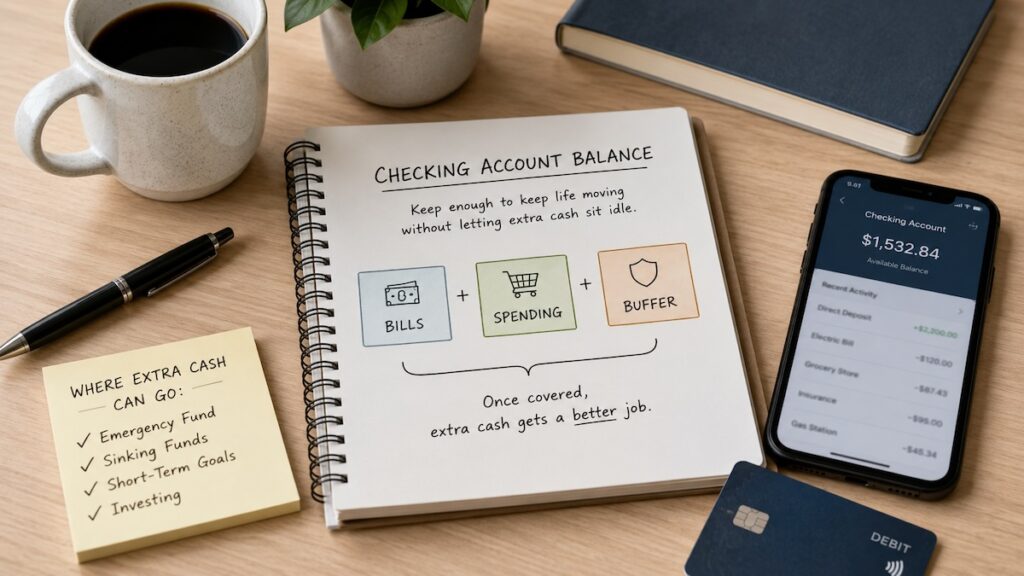
Once your checking account has enough to do its job, extra money should usually move somewhere more intentional.
Emergency savings should have its own clear role. That money is not for normal spending or predictable bills. It exists to protect you when life genuinely disrupts your income, health, transportation, or housing.
Sinking fund money should prepare for expenses you already know will happen eventually. Car maintenance, annual bills, home repairs, holidays, and other predictable costs should not have to compete with everyday checking money. If that part still feels unclear, start with How to Build Sinking Funds That Actually Work.
Short-term goal money may need its own place too. That could include travel, a large purchase, a move, or anything else you are intentionally building toward.
Long-term money may belong outside cash entirely. Once your short-term stability is handled, some money may be better directed toward retirement accounts, investing, or other growth systems.
The exact setup does not have to be complicated. You do not need a separate account for every possible category. The point is simply that extra money should not sit in checking by default.
It should have a reason for being where it is.
That is what makes your financial system easier to understand. You are not trying to give every dollar a tiny assignment. You are giving each pool of money a clear job, so your cash stops blending together into one confusing balance.
How to Find Your Own Checking Account Balance Number
Start by looking at one normal month.
If you need a simpler way to see what normally comes in and goes out, How to Budget Your Money the Simple Way walks through that foundation without turning budgeting into a daily task.
Write down the bills and regular spending that usually move through checking. Do not try to make it perfect. Just get a clear estimate of what the account needs to handle.
Then look at your income timing.
Do you get paid weekly, biweekly, twice a month, monthly, or irregularly? The farther apart your paychecks are, the more your checking account may need to hold. If your income changes from month to month, you may need a larger buffer so the system does not break during lower-income periods.
Next, choose a floor.
This is the minimum checking account balance you want to keep after bills and normal spending clear. It should be enough to prevent timing stress, but not so much that every extra dollar gets trapped in checking.
For example, someone with predictable income may choose to keep one pay period of expenses plus a $500 cushion. Someone with irregular income may prefer one month of expenses plus a larger cushion. Someone who runs most bills through checking may keep more there than someone who uses another account as their main cash hub.
The number should match your life.
Once you find a workable floor, the system becomes easier. When checking rises above what it needs, the extra money can move to savings, sinking funds, or investing. When checking falls below the floor, you know the account needs attention before you spend more freely.
That simple boundary removes a lot of guesswork.
Do Not Let Checking Become Your Whole Money System
Checking accounts are convenient, but convenience can become clutter.
When every type of cash lives in the same account, your balance stops telling the truth. One number may be carrying money for bills, protection, predictable expenses, and actual spending all at once.
That is too much meaning for one balance to carry.
A better system does not need to be complicated. It just needs to make your money easier to read.
The same idea applies to savings categories too. How to Keep Sinking Funds Simple as Life Changes shows how to keep those roles clear without building a complicated system.
Checking is for money that needs to move soon.
Savings is for money that needs to wait.
Investing is for money that needs to grow.
Those roles can be adjusted based on how your accounts are set up, but the principle stays the same. Each pool of money should have a clear job. When it does, your checking account balance becomes less emotional. It is no longer a vague signal of whether you are doing well or falling behind. It is simply the working balance for the part of your money that is currently in motion.
That is the real goal.
Not a perfect number.
A clearer system.
A Calm Close
Your checking account balance should be high enough to keep your life running smoothly, but not so high that money without a clear job sits there by default.
For most people, that means keeping enough in checking for bills, spending, and a small buffer. Once that account has enough breathing room, extra cash should usually move somewhere more intentional.
That extra cash may belong in your emergency fund, a sinking fund, a short-term goal, or long-term growth.
The point is not to overmanage your money. It is to stop letting one account carry every responsibility.
A checking account should help your money move. It should not hide your priorities, blur your savings, or make extra cash feel more available than it really is.
When your checking account has a clear job, the balance becomes easier to trust. You know what it is for. You know when it has enough. And you know when extra money is ready to move somewhere better.
That is how your cash starts to feel calmer, clearer, and easier to manage.